
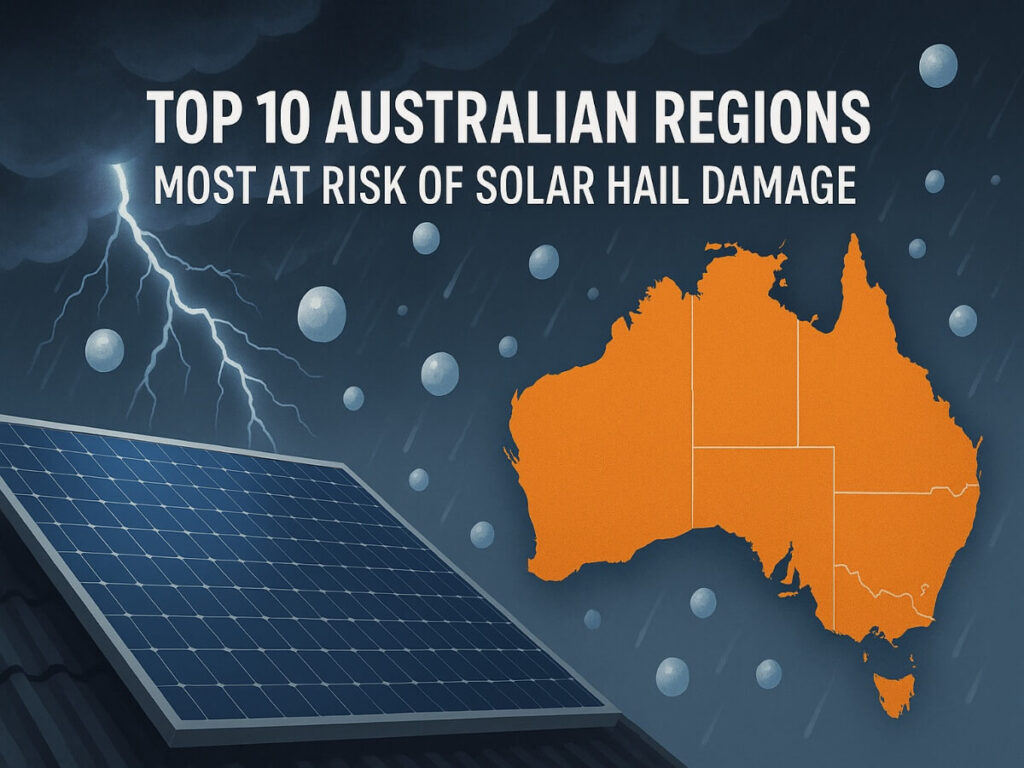
Top 10 Australian Regions Most at Risk of Solar Hail Damage
Australia’s solar adoption continues to rise — but so does the intensity of our storms.
Hail has quickly become one of the most common and costly threats to rooftop solar systems, especially in regions prone to supercells, cold fronts, and unpredictable seasonal patterns.
Knowing whether your home is in a high-risk hail zone can help you prepare, protect your system, and avoid expensive damage.
Here are the top 10 Australian regions most vulnerable to solar hail damage, based on recent storm activity, climate data, and insurance reports.
1. South-East Queensland (SEQ)
Includes: Brisbane, Ipswich, Logan, Redlands, Moreton Bay
Often called Australia’s “hail capital,” SEQ experiences frequent supercell storms every year.
Large hailstones — often 4–8 cm, sometimes up to 12 cm — cause widespread solar panel destruction.
Solar owners in this region are strongly advised to install protective systems before storm season.
2. Gold Coast & Hinterland
The Gold Coast sees severe thunderstorm activity funnelled in from inland heat pockets and coastal moisture.
Hinterland suburbs like Nerang, Mudgeeraba, Oxenford, and Upper Coomera often take the brunt of hail outbreaks.
3. Western Sydney
Areas such as Parramatta, Penrith, Blacktown, Liverpool, and Campbelltown frequently experience high-intensity hail.
Sydney’s inland basin can amplify storm development, making solar systems highly vulnerable.
4. Canberra & ACT Surrounds
Despite its cooler climate, Canberra has a long history of hail devastation — including the infamous 2020 storm where $1.6 billion in hail damage occurred.
Solar systems on flat or gently pitched roofs are especially exposed in this region.
5. Newcastle & Hunter Valley
The combination of coastal moisture and inland heat creates ideal storm conditions.
Suburbs across Maitland, Cessnock, Singleton, and Newcastle often report large hail during summer peaks.
6. Central Queensland (CQ)
Rockhampton, Yeppoon, Gladstone, and Gracemere frequently experience unpredictable hail events due to tropical conditions meeting inland storm fronts.
Solar installations in CQ are rapidly increasing, making protection more essential than ever.
7. Toowoomba & Darling Downs
Storms rolling in from western Queensland often intensify around the plateau, producing fast, hard-hitting hail.
Toowoomba’s elevation and temperature fluctuations contribute to frequent hail formation.
8. Adelaide Hills & South Australia’s Mid-North
Areas such as Gawler, Tanunda, Mount Barker, Clare, and the Adelaide Hills are prone to severe hail due to sweeping cold fronts moving up from the south.
9. Melbourne’s Outer Eastern Suburbs
Melbourne’s storms often strike hardest in suburbs like Lilydale, Croydon, Bayswater, Ferntree Gully, and Belgrave, where cool air from the Dandenong Ranges interacts with warm northern air masses.
10. Southern WA (Perth Hills, Swan Valley, Bunbury)
Southern Western Australia sees seasonal hail outbreaks driven by strong cold fronts from the Indian Ocean.
Perth Hills, Kalamunda, Armadale, and Albany are known hotspots.
Why These Regions Are So High-Risk
Hail risk increases in areas prone to:
- Fast vertical weather movement (ideal for hail formation)
- Colliding warm and cold air masses
- Moisture-laden coastal winds
- Inland evaporation creating high storm energy
- Frequent supercells
- Unpredictable temperature swings
Unfortunately, these conditions are becoming more common, not less.
What Solar Owners Should Do
If you live in one of these regions, your solar system is more vulnerable than the national average.
The smartest protection strategy:
- Install a hail net system
- Inspect your solar before and after storm season
- Protect the edges and corners of your panels (most fragile)
- Use non-intrusive solutions that don’t void warranties
- Keep insurance documentation up to date
HailProtect’s net-based design provides a simple, affordable shield against severe hail without drilling or modifying your roof or solar panels.
Final Thoughts
Australia’s weather is evolving — and solar owners must evolve with it.
Whether you’re in Brisbane, Canberra, Perth Hills, or Western Sydney, the cost of hail damage can be devastating.
A low-cost protective solution can save thousands and keep your home powered no matter what the storm season throws your way.